
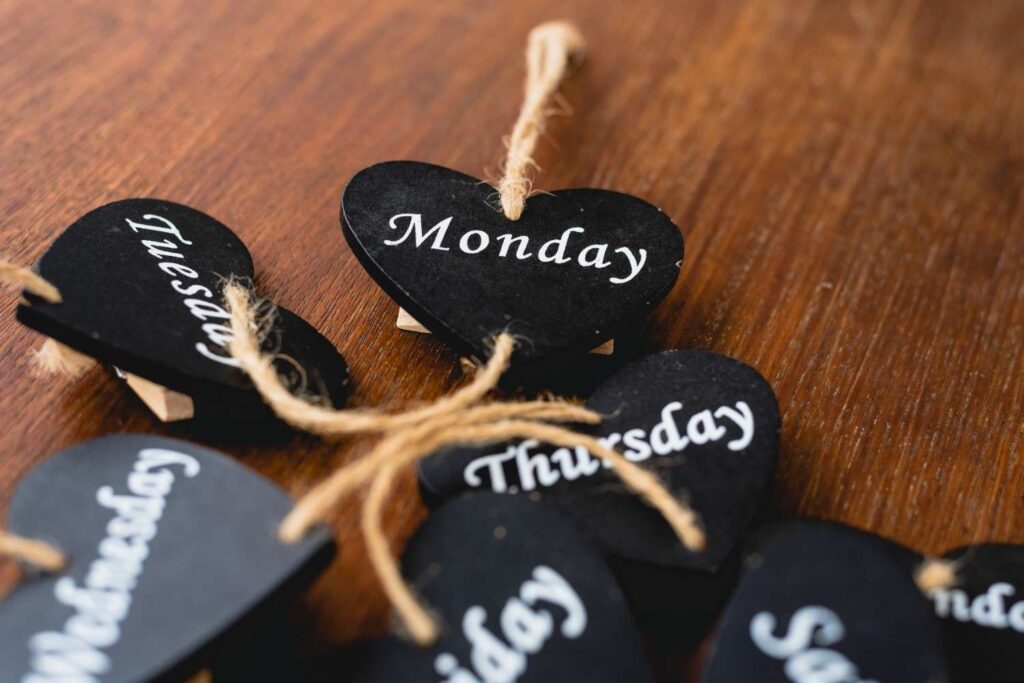
So this is embarrassing, but I’m going to tell you anyway. Last year, I was at a French restaurant in my city, and the waiter asked me what day I wanted to book a table for. I literally just stared at him blankly. Mardi? Vendredi? I had no clue what came out of my mouth. The guy just nodded politely and wrote something down, probably hoping I wasn’t a complete disaster. That’s when I decided I couldn’t keep being that person—the one who nods along to French days of the week like I understand anything.
Here’s what nobody tells you about learning a new language: it’s awkward as hell at first. But you know what? After actually sitting down and forcing myself to learn this stuff properly, it’s become one of those things I’m weirdly proud of. So let me walk you through what I did, because honestly, if I can figure this out, literally anyone can.
The Seven Days: Breaking Down Each One
Starting With Monday (Lundi)
Monday is lundi. Simple enough, right? Well, I thought so too. But then I kept pronouncing it wrong for like two months straight. I was saying “loon-dee” like it rhymed with “woody,” when really it’s more like “loon-dee” but with a softer ending. My French coworker finally corrected me after I’d said it about a hundred times in the wrong way. The word comes from “lune,” which means moon. That’s actually kind of cool when you think about it—Monday is literally moon day in French. I started using that connection to remember it, and it stuck way better than just drilling the word.
Tuesday Through Thursday (Mardi, Mercredi, Jeudi)
Okay, mardi is Tuesday, and it’s named after Mars, the god of war. I remember that because it sounds vaguely like “martial,” which made sense to my brain. Tuesday as war day? Sure, why not. Then comes mercredi for Wednesday, and this is where I wanted to throw my laptop out the window. That “r” sound in the middle of the word? It’s not like anything in English. I was rolling my Rs like I had pebbles in my mouth. My roommate finally told me to stop trying so hard and just let my tongue chill in my throat more. Once I stopped forcing it, it got easier. Mercredi comes from Mercury, the messenger god, in case you were wondering. Wednesday as Mercury day—the Romans really thought this through.
Then there’s jeudi for Thursday. This one has that weird nasal sound that English doesn’t really have. I spent actual hours listening to French people say it on YouTube videos. I’d pause, try it, pause again, try it again. My family thought I was losing it. But jeudi comes from Jupiter, which is kind of badass when you think about it. The king of the gods gets Thursday.
Friday (Vendredi)
Vendredi is Friday, and it’s named after Venus, the goddess of love. That’s actually romantic if you’re into that sort of thing. I remember vendredi because once I learned that Venus connection, it made sense. “Ven” sounds vaguely like Venus, and the rest of the word follows. For some reason, this one clicked for me faster than the others. Maybe because Friday already feels special in my mind, so having it connected to the goddess of love made it stick.
Saturday and Sunday (Samedi and Dimanche)
Samedi is Saturday, and honestly, this one is way easier than the others. It comes from the Sabbath, which is why it sounds kind of religious. Say it a few times and it just works. Dimanche is Sunday, and it literally means “the Lord’s day.” That was actually helpful for me because once I knew that, I remembered it easily. Religious days were easier to latch onto than planetary gods, I guess.
Okay, So How Do You Actually Say These Things?
Here’s the real talk: I probably butchered these pronunciations for months. But here’s what I figured out—French people are usually pretty forgiving if you’re clearly trying. They don’t expect perfection.
The way I learned was by watching this one French teacher on YouTube named Madame Marie. She would say each day three times, slowly, and I’d just repeat it back like she could hear me (she couldn’t, obviously). I did this for like fifteen minutes every morning for a month. Sounds boring? It kind of was. But it worked. My mouth eventually learned the shapes it needed to make.
Lundi is “LOON-dee.” Mardi is “MAR-dee” with the r being from your throat, not your teeth. Mercredi is “mehr-kruh-DEE” and honestly, just don’t stress the r too much. Jeudi is “JUH-dee” with that nasal vowel that sounds like nothing from English. Vendredi is “vahn-druh-DEE.” Samedi is “SAM-uh-dee.” And dimanche is “dee-MANSH” where the last part rhymes with “branch.”
I still mess these up sometimes. But I’ve stopped caring because people understand me anyway.
When I Actually Had to Start Using These Things in Real Life
The First Time I Used Them
I’ll never forget the first time I used the French days of the week in an actual sentence without completely panicking. I was texting a French friend named Sophie about hanging out, and I wrote, “Je suis libre le samedi” (I’m free on Saturday). I almost deleted it before sending because I was terrified it was wrong. But I sent it anyway. You know what happened? She replied immediately like it was the most normal thing in the world. Because it was.
After that, I started getting braver. I’d ask people, “Quel jour sommes-nous?” (What day is it?) even though I could literally check my phone. But I asked anyway because I needed the practice, and people were always nice about answering.
Work Stuff Got Real
Fast forward a few months, and I started doing freelance work with some French companies. Suddenly, I’m looking at calendars that say “lun. 10h,” “mer. 14h,” stuff like that. At first, I had to look up what the abbreviations meant every single time. Then I just… knew them. One day I was reading an email with meeting times, and the abbreviations made instant sense. That was a cool moment.
My coworker sent me a meeting request that said “Jeudi 9h pour discuter du projet.” I understood it immediately. Thursday at 9am to discuss the project. Three months before, that would have taken me five minutes to decipher. Now it was automatic. That’s when I realized I’d actually learned this stuff.
How French People Actually Use These Days
Here’s something important I learned: French people don’t capitalize these days. Like, ever. Unless it’s at the beginning of a sentence. I was writing emails all properly capitalized with “Lundi” and “Mardi,” thinking I was being super professional, and my manager gently asked why I was doing that. Turns out it’s wrong. In French, you write “Je travaille lundi” (I work Monday) with a lowercase m. It’s just a convention, but it matters if you want to sound like you know what you’re doing.
Also, when talking about things that happen every Monday or every Tuesday, you say them differently than you’d expect. You don’t just say “je travaille lundi.” You say “je travaille le lundi.” That little “le” changes it from “I work Monday” (one specific Monday) to “I work on Mondays” (every Monday). I got tripped up on this for ages until someone explained it to me properly.
The Tools That Actually Helped Me
What Worked and What Was a Waste of Time
Flashcards? Meh. I made them, I used them for like a week, then forgot about them. But honestly, just writing the days on a piece of paper and looking at it while I ate breakfast every morning worked better. There’s something about seeing them in your normal routine that makes them stick.
The Duolingo app had a section on this, and I did it a couple times. It was fine. Not exciting, but fine. What really moved the needle was just using these words in actual contexts. I’d write out my weekly schedule in French. I’d label my calendar in French. I’d text my friends in French about what day I wanted to hang out.
I tried one of those language apps with the little repeating exercises, and they were okay I guess. But the real breakthrough came when I just started living with these words instead of studying them. There’s a big difference.
When I Got an Actual Coach
After a few months of struggling on my own, I realized I was hitting a wall where nothing was improving. I looked into getting proper lessons, and I found Berliners Institute. Honestly, having someone walk me through not just the words but like, how to actually use them in real situations, made a huge difference. It’s one thing to memorize that lundi means Monday. It’s completely different when someone explains to you how French people actually talk about days, what phrases you’d use, how to understand the rhythm of the language. That context made everything click into place so much faster.
I’m not saying you need to spend money to learn the French days of the week. You don’t. But if you’re struggling after trying on your own for a while, getting professional help is worth it. Someone who actually knows French and knows how to teach it can save you months of frustration.
Questions People Actually Ask Me About This
“Why do they have different names than English?”
Okay, so the Romans basically named these days after planets and gods. English did the same thing, but then things changed over time. Monday in English used to be Moon’s day, which is basically the same as the French lundi (Lune = Moon). But for whatever reason, French kept more of the Roman naming structure, and English evolved differently. It’s actually pretty interesting if you’re into language history, but honestly, it doesn’t really matter for learning them. They’re just different names for the same days.
“Is it going to take me forever to learn these?”
Nope. If you actually sit down and work at it, you can be comfortable with the French days of the week in like two weeks. I’m serious. Spend twenty minutes a day saying them out loud, writing them down, using them in sentences, and by the end of two weeks, they’re in your head. It’s not that long when you actually focus.
“What if I keep forgetting them?”
Welcome to being human. I still have moments where I blank on one. But here’s the thing—the more you use them in actual contexts, the less you’ll forget. There’s no magic pill. It’s just repetition and use. I forget the pronunciation sometimes, but I never forget which day is which anymore because I use them all the time.
“Should I learn them in a specific order?”
I’m going to be honest—I learned them all at once, and it was kind of messy. Would it have been better to learn Monday, then Tuesday, then Wednesday? Maybe. But I think once you learn a few of them, your brain kind of picks up the pattern and the rest just follow. Try learning Monday through Wednesday really well first, then add the rest. That might work better than throwing all seven at yourself.
Real Talk: Why This Matters
Here’s what I realized after actually getting competent with the French days of the week: it’s not just about the words. It’s about the fact that you’re putting in the work to actually communicate with French speakers. When I got to the point where I could naturally say “Rendez-vous mercredi” without thinking, it wasn’t just cool because I learned a new thing. It was cool because I was actually becoming part of the conversation. I wasn’t translating in my head anymore. I was just… speaking.
That’s the real goal here. Not to memorize seven words. But to get to the point where these French days of the week feel like a natural part of how you talk, just like they are for French people.
The journey from that embarrassing moment in the restaurant to now has been kind of ridiculous. I’ve butchered pronunciations, confused people, made mistakes, looked stupid, felt frustrated, and wanted to give up about a hundred times. But I didn’t. I just kept showing up and trying. And gradually, it got easier. That’s the whole thing right there.
If you’re starting this journey, be patient with yourself. You’re going to sound weird at first. You’re going to mix things up. You’re going to have moments where you just blank and can’t remember if it’s mardi or mercredi. That’s completely normal and fine. Everyone who actually became fluent in anything started exactly where you are.
So start today. Pick lundi, say it out loud a bunch of times, text a French friend about it, use it in a sentence. Do the same tomorrow with mardi. Keep going. In a couple weeks, you’ll be surprised at how normal this all feels. And if you want someone guiding you through it, Berliners Institute can help you get there faster with their French courses. Either way, you’ve got this. The fact that you’re even reading this means you’re already taking it more seriously than most people do.