German Language Course Fees in India: What Online and Classroom Courses Really Cost (2026)
By Berliner Institute Editorial Team · Updated October 2026 · Gurugram
Introduction
Ask five institutes what a German course costs and you will get five different numbers — and all of them will be technically correct, because they are pricing five different things. If you are comparing a german language course to learn german online, or weighing german classes near you against a national online brand, this guide explains what those numbers are made of, why online and classroom prices diverge, and how to compare two quotes without getting played. Ground rule for this article: no fixed rupee figures. Fees shift by city, format and year, and any number printed here would be stale before you finish reading. What you get instead is the anatomy of a fee — every component, every cost driver, every question that reveals whether a quote is honest. Berliner Institute is a foreign language courses institute in Gurugram teaching German from A1 to C2, and this is how we explain our own pricing to prospective students.
Inside: what a course fee actually buys, the five things that decide the price, where online and classroom money goes, how to read a fee quote, the traps to avoid, and how to compare two institutes fairly.
What a Fee Actually Buys
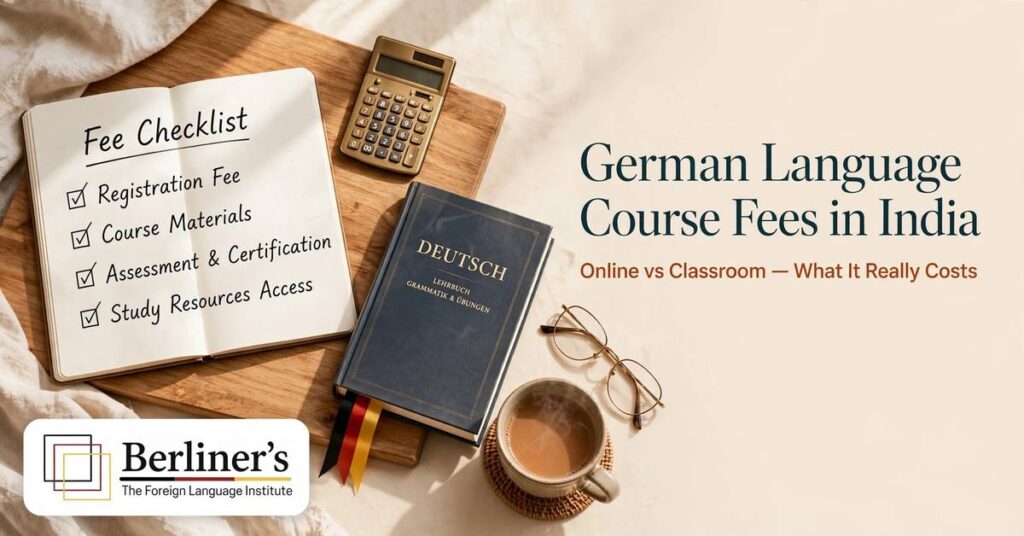
A German course fee is not one thing. It is a bundle: teaching hours at a defined CEFR level, a teacher’s time, batch size (your share of the teacher’s attention), study material, mock tests and exam preparation, and the institute’s overheads — rent for classrooms, the Zoom licence for online batches, admin staff. When two fees differ, they differ in one or more of these components. The beginner’s mistake is comparing totals; the skill is comparing components.
The Five Things That Decide the Price
1. Batch size — your share of the teacher
The single biggest cost driver. A batch of four students gives you many times the speaking time of a batch of forty — and costs more per head, because the teacher’s salary is split fewer ways. Small batches are not a luxury feature; in a speaking-heavy skill like German, they are the product. When a course is suspiciously cheap, batch size is usually where the saving came from.
2. Teacher quality
Trained, certified teachers who know the Goethe exam format cost more than whoever was available this month. Here is the uncomfortable truth: you are not paying for information — German grammar is free on the internet. You are paying for correction: someone who hears your mistakes, which you cannot hear yourself.
3. Hours per level
A genuine A1 level is 60+ hours of teaching. A 30-hour “A1” is half a level wearing a full-level badge — it looks cheaper because it is smaller. Always ask for hours per level before asking for the fee. At Berliner Institute, group levels run a minimum of 60 hours, one-on-one programs a minimum of 40.
4. Exam preparation: built in or bolted on
Some institutes include Goethe mock tests, sample-paper practice and exam technique in the course fee. Others teach general German and then sell “exam preparation” as a separate paid module at the end. Neither model is dishonest — but only one lets you compare headline fees fairly, so ask which one you are looking at.
5. Format: online vs classroom
Classroom batches carry rent, utilities and physical infrastructure; online batches carry technology costs and can serve students across cities. This is why online courses are often priced lower. But “online” covers everything from live small-group Zoom classes to recorded video libraries with no teacher at all. The word tells you the delivery method, not the teaching quality — and the price should reflect that distinction.
Online vs Classroom: Where the Money Goes
Let us follow the money in each format, because the sticker price hides real costs on both sides.
What makes online cheaper — and when it isn’t
Online courses skip classroom rent, so honest institutes pass some of that saving to you. But online has its own costs: small live batches still need the same teacher-hours, and good institutes invest in proper audio, digital whiteboards and learning platforms. The online courses priced dramatically below everything else are usually recorded-only: no live teacher, no speaking correction, no one noticing when you stall at A2.
The hidden costs of classroom learning
Classroom fees look higher, and they are — but add the invisible line items before you decide. Commuting across Delhi NCR can eat two hours a day plus a meaningful monthly sum in metro fares or fuel. Then there are the missed classes from traffic, rigid batch timings that clash with office hours, and the simple fact that the best classroom institute might be across the city from you.
The format that actually saves money
The cheapest course is the one you finish. A slightly pricier live online batch you attend faithfully for four months beats a cheap classroom course you abandon in week three because the commute broke you.
How to Read a Fee Quote Without Getting Played
Get any quote in writing and run it through these questions. Honest institutes answer all of them without flinching.
The questions that matter
How many teaching hours per level? What is the maximum batch size? Are the teachers trained and certified — and can I meet mine before paying? Is Goethe exam preparation included, or charged separately? Is study material included? What is the per-level fee versus the full-course fee, and am I being pressured to pay everything upfront? What is the refund or batch-transfer policy if my schedule changes? A quote that answers these is a quote you can trust. A quote that dodges them is telling you something too.
Never pay for everything upfront
This is the oldest rule in the book and still the most broken. Pay per level, after a demo class. An institute confident in its teaching never needs your B2 money while you are still at A1.
The Price Traps to Avoid
The too-cheap A1
If one institute charges half of what three others charge for A1, it is not more efficient — it is smaller on hours, batch size, teacher quality or exam prep. There is no secret to teaching German cheaply; there are only corners, and they get cut where you can’t see them.
Fluency guarantees
“B2 in six months, guaranteed” is not a promise; it is a sales line. Language learning has too many variables — your hours, your consistency, your attendance — for anyone to guarantee outcomes. Guarantees signal marketing budget, not teaching quality.
The free course that isn’t
Free demo classes are genuine; free full courses are funnels. If the “free” course ends with high-pressure upselling and a countdown timer, you were the product being sold.
Exam fee confusion
Course fees and the Goethe exam fee are separate things — the exam fee goes to the Goethe-Institut when you register for the exam itself. If a quote bundles them, ask for the split. If a quote never mentions the exam fee at all, remember it exists before you budget.
Comparing Two Quotes Fairly
Put two institutes side by side and normalise: fee divided by teaching hours per level gives you the cost per hour of real teaching — the only number that compares fairly across quotes. Then adjust for batch size (your share of the teacher’s attention), teacher credentials and included exam prep. A course that looks 20% more expensive at 60 hours and four students is usually cheaper per unit of actual learning than a “bargain” 30-hour batch of twenty-five.
Starting at Berliner Institute
Berliner Institute in Gurugram teaches German from A1 through C2 with Goethe-Zertifikat preparation built into the curriculum. Group classes run a minimum of 60 hours per level, one-on-one programs a minimum of 40 hours, batches are capped at four students, and the fee is quoted per level — no pressure to pay for the whole journey upfront. Live online classes run on Zoom with the same teachers and syllabus as the classroom. The institute also teaches French and Spanish.
One demo class
That is all we ask: one free demo — over Zoom or in Gurugram — and you will feel the difference between app-tapping and a teacher correcting you in real time. Visit Berliner Institute, pick German, book your demo today.
Frequently Asked Questions
Why do German course fees vary so much between institutes?
Because a fee bundles different things: batch size, teaching hours per level, teacher quality, included exam preparation and format. A cheap course is usually smaller on at least one of these — compare components, not totals.
Is it cheaper to learn German online?
Often, yes — online batches skip classroom rent. But compare like with like: a live online class with a real teacher is a different product from a recorded video library, and priced accordingly. Factor in your commuting costs before calling classroom learning expensive.
Is the Goethe exam fee included in course fees?
Usually not — the exam fee is paid separately to the Goethe-Institut when you register for the exam. Always ask for the split if a quote bundles the two together.
Should I choose group or one-on-one classes?
Group classes cost less per hour and give you the underrated advantage of hearing other learners’ mistakes corrected. One-on-one compresses the calendar and adapts fully to your pace, at a higher per-hour cost. If budget is tight, a small group batch is the sweet spot.
What should I ask before paying any fee?
Hours per level, batch size, teacher credentials, included exam prep and material, per-level versus full-course pricing, and the refund or transfer policy. Get the answers in writing.
Conclusion
The whole guide in one paragraph: German course fees in India are bundles of teaching hours, batch size, teacher quality, exam preparation and format — online usually prices lower by skipping classroom rent, but live teaching costs the same in teacher-hours either way. The honest comparison is cost per teaching hour, adjusted for how much of the teacher’s attention you actually get.
So stop collecting fee screenshots and start collecting answers. Pick the german language course whose quote survives every hard question, whose batches are small enough that you will actually speak, and whose teachers you have met before paying. When you learn german at an institute that quotes per level and teaches 60+ honest hours of it, the fee stops being a gamble. Book a free demo at Berliner Institute — a foreign language courses institute in Gurugram with small-group german classes online and in the classroom — and judge the teaching before you judge the price.