
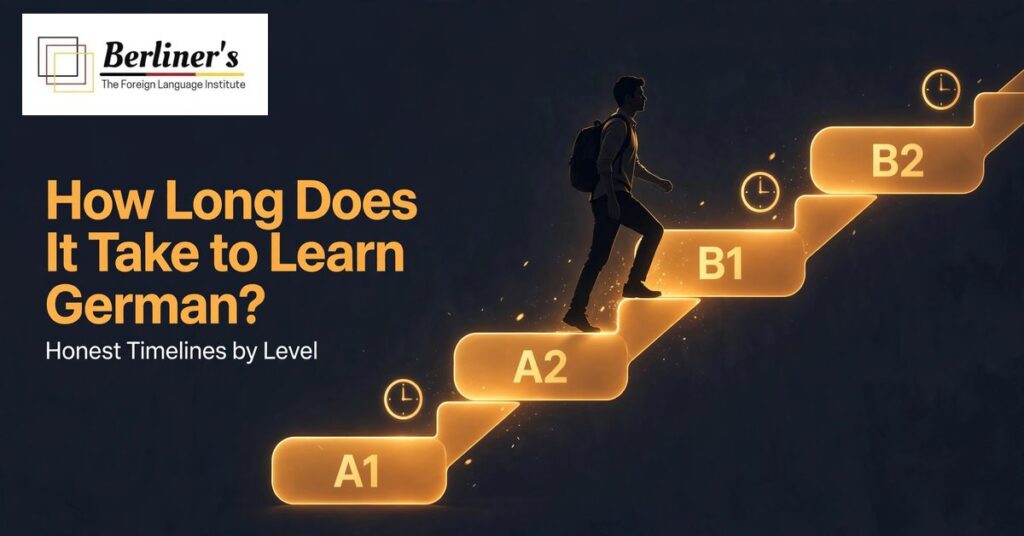
How Long Does It Take to Learn German? Honest Timelines by Level (2026)
By Berliner Institute Editorial Team · Updated October 2026 · Gurugram
Introduction
Ask five institutes how long German takes and you will get five answers — most of them suspiciously short. “Fluent in six months” sells courses; it does not describe reality. So let us start with the honest version, level by level, for real learners in India studying a few hours a week alongside a job or a degree. Anyone seriously weighing german language courses deserves this before spending a rupee — or before comparing foreign language courses more broadly: A1 and A2 take three to four months each, B1 takes four to six months, and B2 — the level that actually unlocks jobs and German universities — takes six to eight months of focused work. If you are planning to learn german in india for a career move or study abroad, the total from zero to B2 is roughly a year and a half to two years. And the best german courses in delhi ncr will tell you that timeline upfront, not after you have paid.
The Honest Answer First
The number everyone wants is simple: about 1.5 to 2 years from zero to B2 with regular classes and daily practice. German is not a fast language. Its grammar is famously structured — genders, cases, verb positions, separable prefixes — and that structure rewards steady, cumulative learning while punishing rushed shortcuts. The good news: German is one of the most predictable languages on the planet. Once you learn the rules, the rules actually hold. Here is what each level honestly costs you in time.
A1: The Start Line — 3 to 4 Months
A1 is survival German: greetings, introductions, numbers, time, shopping, the present tense, basic word order. You learn that nouns have genders (der, die, das) and you memorise them one article at a time, which feels like trivia until it isn’t. Pronunciation is refreshingly logical — German is spoken the way it is written — so beginners make fast early progress on speaking. Nobody can skip A1, and nobody should rush it: a shaky foundation here quietly costs you months later, because every level above assumes the basics are automatic.
What A1 feels like
Encouraging. You go from nothing to holding a simple conversation, reading signs and writing short messages. The grammar is manageable, the vocabulary is concrete, and progress is visible every week. Enjoy it — it is the last easy level.
A2: The Awkward Middle — 3 to 4 Months
A2 is where German starts showing its teeth. Past tenses (perfekt and präteritum), the dative case in earnest, modal verbs, subordinate clauses that shove the verb to the end of the sentence. You can now talk about your past, your plans and your opinions — real social German — but everything takes effort. This is the level where the most learners stall or quit: the novelty is gone, the grammar piles up, and the apps stop helping. Pushing through A2 is a matter of routine, not talent — regular classes, corrected homework, and the discipline to keep going when it stops being fun.
B1: Where German Gets Useful — 4 to 6 Months
B1 is the first level that buys you something. You can travel independently, handle most everyday and work situations, follow the gist of films and news, and express opinions with reasons. The Goethe-Zertifikat B1 is recognised by employers and — importantly — B1 is the level Germany’s family-reunification visa route typically asks for. Grammar-wise, you are now in the thick of it: passive voice, subjunctive II (Konjunktiv II) for hypotheticals, relative clauses, and the full case system working across prepositions. B1 takes four to six months because the leap from “managing” to “independent” is genuinely large. This is the level where small batches start mattering enormously — with four students in a class you speak every session; with thirty, you wait your turn until you forget what you were going to say.
B2: The Professional Threshold — 6 to 8 Months
B2 is the destination for most serious learners, and it is a different beast from everything before it. Fluent, spontaneous interaction with native speakers. Clear, detailed argument on complex topics. Professional-level writing. The Goethe-Zertifikat B2 is the credential German employers, universities and embassies ask for — it is the level that turns German from a skill into a career asset. Six to eight months of focused work is the honest timeline, and “focused” is doing the heavy lifting in that sentence: daily practice, corrected writing, real conversation, mock exams. Anyone promising B2 in three months from zero is either dishonest or teaching a certificate-shaped hallucination. The jump from B1 to B2 is the steepest climb on the whole ladder — vocabulary doubles, grammar has to become instinct, and your ear has to handle real-speed German.
C1 and C2: Mastery — 8 to 12 Months Each
Beyond B2, the returns get specialised. C1 is near-native fluency — nuanced argument, professional and academic writing, the level that lets you study or teach in German. C2 is the summit: effortless, precise German across any domain. Each of these levels takes the better part of a year. Few learners need them; translators, interpreters, teachers and researchers live there. A good institute teaches through C2 but tells you honestly when B2 is enough. For most careers, it is.
What Speeds It Up — and What Slows It Down
Two learners can start on the same day and reach B2 a year apart. The difference is rarely talent. It is method.
The accelerators
Small batches: a four-student cap means you speak every class instead of waiting behind twenty people. Daily practice: thirty focused minutes a day beats a heroic five-hour Sunday. Corrected feedback: a teacher marking your writing and fixing your speaking errors is worth more than a hundred app exercises. Consistent attendance: every skipped week costs two. And genuine immersion on the side — German films with subtitles, news podcasts, changing your phone’s language once you dare.
The brakes
Irregular attendance is the classic killer. So is the pause-restart cycle: finishing A2, stopping for six months, and restarting at A1 because everything evaporated. Apps as the main method — fine as a supplement, fatal as a strategy, because nothing corrects your sentences. Batches of thirty where you never open your mouth. And the most German-specific brake of all: trying to memorise your way through cases and genders without speaking enough to make them automatic.
The Exam Map: Which Certificate for What
Timelines only matter if they end somewhere. In German, the exam that matters is the Goethe-Zertifikat, issued by the Goethe-Institut and recognised by employers and universities worldwide. There is a Goethe exam for each level, A1 through C2, each testing reading, writing, listening and speaking. Other providers — telc and ÖSD — issue respected certificates too, but Goethe is the name Indian employers and German embassies reach for first. The practical advice: prepare level by level with your institute, and sit the exam at the level you actually need — B1 for visa routes, B2 for jobs and universities. Aim your entire learning plan at the exam from day one, not as an afterthought when the course ends.
Starting at Berliner Institute
Berliner Institute in Gurugram runs foreign language courses in German, French and Spanish from A1 through C2. For German, group levels run a minimum of 60 hours and one-on-one a minimum of 40 — a level is a real unit of learning, not a calendar month — with batches capped at four students so you actually speak every class. Exam-focused preparation for the Goethe-Zertifikat is built into the curriculum, and live online classes run over Zoom with the same teachers and syllabus as the classroom.
One demo class
That is all we ask. One free demo — in Gurugram or over Zoom — and you will feel the difference between app-tapping and a teacher correcting your German in real time. Visit Berliner Institute, choose German, and book your demo today. The two-year path to B2 starts with a single honest hour.
Frequently Asked Questions
Can I learn German to B2 in one year?
From absolute zero, no — not honestly. Zero to B2 takes roughly 1.5 to 2 years of regular classes with daily practice. Anyone promising it in a year is cutting corners you will pay for at the exam.
Is German harder than French or Spanish?
German grammar is heavier — cases, genders, verb positions — but its pronunciation and spelling are far more logical than French. Most Indian learners find German’s rules demanding but predictable: once learned, they hold. French trips learners up with exceptions; German trips them up with structure.
Which German level do I need for jobs in India?
B2 is the professional threshold most employers use — BPOs, IT, tourism and teaching roles. B1 qualifies you for entry-level customer support positions. C1 opens translation, interpretation and senior corporate roles.
Do I need the Goethe-Zertifikat, or is a course certificate enough?
The Goethe-Zertifikat is the credential employers and embassies trust; a course completion certificate from an institute carries far less weight. If you are learning German for jobs or study abroad, aim for the Goethe exam from day one.
Can I learn German effectively online?
Yes — provided the course has live teachers, real speaking practice and exam preparation built in. Live online classes work as well as physical classrooms for most learners. Skip recorded-only courses either way.
Conclusion
The whole guide in one paragraph: learning german to b2 takes roughly 1.5 to 2 years of honest work — three to four months each for A1 and A2, four to six for B1, six to eight focused months for B2 — and the variables that decide your personal timeline are batch size, daily practice, corrected feedback and consistency, not talent. Choose german classes that give each level its full hours, aim your plan at the goethe-zertifikat from day one, and treat “fluent in six months” as the marketing slogan it is. If you are comparing foreign language courses for your career, German remains one of the highest-payoff languages an Indian learner can pick — and the path to B2 is long, predictable and entirely walkable.
So stop shopping for the fastest course and start shopping for the most honest one. One demo, one real lesson, and you will know within the hour whether the institute fits. Book your free demo at Berliner Institute today — two years from now, you will wish you had started today.