
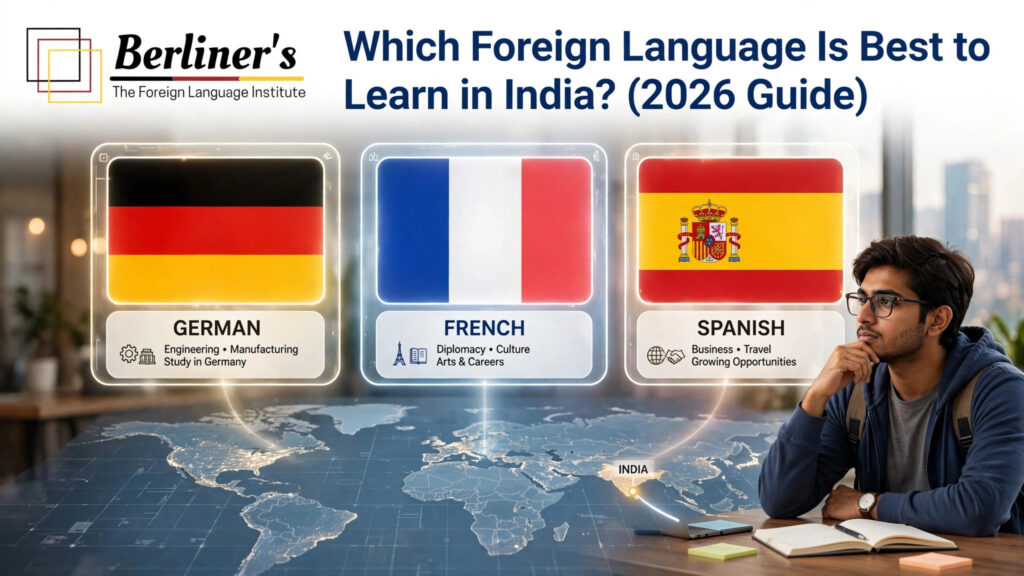
By Berliner Institute Editorial Team · Updated October 2026 · Gurugram
Which Foreign Language Is Best to Learn in India for Jobs?
Introduction
Everyone asks this question. Almost nobody answers it honestly. The honest answer: it depends on what you want — the fastest paycheck, the biggest paycheck, or the most doors opened. There is no single “best” foreign language, but there is a best language for you, and you can find it in about five minutes with the right comparison. So here it is: Spanish, German and French — the three languages that actually drive foreign language jobs in india — compared on the only four things that matter: salary, demand, learning time, and the certificate that unlocks it all.
The Salary Scoreboard
Let’s start with money, using job search engine Adzuna’s analysis of 2.5 lakh Indian postings:
German: ₹10,40,000/year average — the highest. Germany’s industrial footprint in India (automotive, engineering, chemicals) plus tight supply of certified speakers keeps German at the top of the pay scale. Freshers start at ₹4.5–6 lakh; experienced professionals reach ₹10–18 lakh.
Spanish: ₹9,80,000/year average. BPOs serving US Hispanic and Latin American markets, IT, pharma exports and tourism drive broad demand. Freshers start at ₹3.5–5 lakh; experienced professionals reach ₹8–15 lakh.
French: ₹9,65,000/year average. BPOs, Francophone-Africa business, hospitality and luxury, plus the Canada-immigration economy. Freshers start at ₹3.5–5 lakh; experienced professionals reach ₹8–15 lakh.
The gap between first and third is real but not dramatic — roughly 8%. All three roughly double the national average salary. The takeaway: you can’t pick badly on salary alone. So the decision comes down to the other three factors.
Demand: Where the Jobs Actually Are
German demand is structural and industrial — engineering, automotive, manufacturing, SAP consulting. It concentrates in technical and corporate roles, and it has held steady for over a decade. If you have (or want) a technical or engineering background, German demand is built for you.
Spanish demand is the broadest — BPOs and customer experience at volume, IT, pharma exports, tourism, teaching. It doesn’t depend on any single sector, which makes it the most resilient of the three. If you want the maximum number of doors, Spanish opens the most.
French demand is the most diverse in character — BPOs, Francophone-Africa operations, luxury and hospitality, diplomacy and international organisations, and the Canada-immigration ecosystem. If Canada, luxury, or international institutions appeal to you, French is the only choice of the three.
Learning Time: How Fast to a Paycheck
This is where the three diverge sharply — and where most learners pick wrong by ignoring it.
Spanish is the fastest: 1 to 2 years to B2 (the professional threshold). Phonetic spelling, familiar Latin script, grammar with fewer exceptions. If you want the shortest road from classroom to salary slip, this is it.
French takes 1.5 to 2 years to B2. More grammar exceptions than Spanish — genders, conjugations, silent letters — but very manageable with structured learning.
German takes 2 to 2.5 years to B2. Cases, genders, word order: German grammar demands real bedding-in time. It’s the longest road of the three — compensated by the highest pay at the end of it.
The honest math: Spanish gets you earning roughly a year sooner than German. Over a career, German’s salary premium outweighs that head start — but only if you actually finish. A language you complete beats a language you abandon, every time.
The Certificates: Your Actual Ticket
Employers don’t hire “fluent in [language]” — they hire certificates. Each language has exactly one that matters:
Spanish → DELE (Diplomas de Español como Lengua Extranjera), issued by Spain’s Instituto Cervantes. B2 is the professional threshold.
German → Goethe-Zertifikat, issued by the Goethe-Institut. B2 is the professional threshold; German employers are famously credential-conscious.
French → DELF (Diplôme d’Études en Langue Française), issued by France’s Ministry of Education. B2 is the professional threshold; DALF covers C1/C2.
Whichever language you choose, aim your entire learning plan at the B2 exam from day one. The certificate is the difference between “I know some Spanish” and a shortlisted resume.
So Which One Should You Pick?
Here’s the decision framework, no hedging:
Pick Spanish if you want the fastest route to earning, the broadest set of industries, or you’re a working professional who needs to reach B2 without pausing your life. The 1-to-2-year path to employability is unmatched.
Pick German if you want the highest salary ceiling, you have (or are building) a technical, engineering or IT background, or a future move to Germany appeals to you. The road is longer; the pay is the best in the field.
Pick French if Canada is in your plans (French boosts Express Entry CRS scores), you’re drawn to hospitality, luxury, diplomacy or international organisations, or you want strong demand with a distinctive profile. French plus ambition travels well.
Still stuck? Ask yourself one question: do you want money fastest, or most? Fastest → Spanish. Most → German. Everything else → French. That’s the whole decision.
The Rule That Beats the Choice
Here’s what matters more than which language you pick: language plus domain. The German-speaking engineer, the Spanish-speaking commerce graduate handling Latin American accounts, the French-speaking hospitality professional — these hybrid profiles earn far more than pure translators in any language. Don’t abandon your degree to learn a language. Attach the language to your degree, and let the combination do the pricing. This rule holds for all three, and it’s the real answer to “which foreign language is best to learn in india” — the best language is the one stacked on top of skills you already have.
Starting at Berliner Institute
Whichever of the three you choose, the path is the same: structured learning ending in certification.
Why structured beats solo
Most self-learners fail identically: no speaking practice, no feedback, no exam plan. They study for a year, freeze in real conversation, walk into the exam unprepared for the format, and conclude “languages aren’t for me.” The method failed, not the learner. A proper institute fixes exactly this — structured levels, live interaction, mock tests, and a straight road to DELE, Goethe or DELF.
What you get at Berliner
Berliner Institute in Gurugram teaches all three — Spanish, German and French — from absolute beginner through advanced levels, with exam-focused preparation built into the curriculum. Classroom and online batches, trained teachers, interactive classes, schedules designed for students and working professionals. One institute, three languages, zero need to start over somewhere new if your ambitions shift.
One demo class
That is all we ask. One demo, and you will feel the difference between app-tapping and real learning. People building foreign language jobs in india careers through Berliner all started the same way — curious, half-convinced, and converted by a single class. Visit berliners-institute.com and book a free demo today.
Frequently Asked Questions
Which foreign language is best to learn in India for jobs?
German pays the most (₹10.4L average), Spanish gets you earning fastest (1–2 years to B2) with the broadest demand, and French offers the most diverse opportunities including Canada immigration. Pick by your goal: fastest paycheck → Spanish; highest pay → German; most diverse doors → French.
Which foreign language has the highest salary in India?
German, at an average of ₹10.4 lakh per year (Adzuna, 2.5 lakh postings), followed by Spanish at ₹9.8 lakh and French at ₹9.65 lakh. All three roughly double the national average salary.
Which is easier to learn: Spanish, French or German?
For most Indian learners, Spanish is the most approachable (phonetic, 1–2 years to B2), French is moderate (1.5–2 years to B2), and German is the most demanding (2–2.5 years to B2) — with the highest salary compensating for the extra effort.
Which foreign language is best for Canada immigration?
French. Canada’s Express Entry system awards CRS points for French proficiency (tested via TEF Canada), making French the strategic choice for anyone planning Canadian immigration.
Can I learn a foreign language while working full-time?
Yes — Spanish is the most working-professional-friendly due to its shorter path to B2, but all three are learnable alongside a job with live online classes scheduled for evenings and weekends.
Conclusion
Here is the whole comparison in one paragraph. Foreign language jobs in india pay ₹3.5–6 lakh to freshers and ₹8–18 lakh to experienced professionals across the board; German leads on salary (₹10.4L average), Spanish leads on speed (1–2 years to B2) and breadth of demand, French leads on diversity of opportunity; B2 certification (DELE, Goethe or DELF) is the universal hiring threshold; and language-plus-degree beats language alone in every case. Pick by your goal, commit to B2, and start.
Stop researching and start. Book your free demo at Berliner Institute today — Spanish, German or French, from beginner to advanced, exam-focused, online and in Gurugram. Two years from now, you will wish you had started today.